'The end.' is what the paper said,
Words that truly transcend,
A sudden quiet in my head.
I slowly close the final page,
The real world feels just like a cage,
Reminding me again of life's rage.
Oh, how I wish I had amnesia,
To read it again, resting on my ilia,
And satisfy my LitPhilia.
There aren't many corners of the internet that feel like they were made for people who actually love books.
"Litphilia" isn't a made-up tech word. It comes from lit — literature — and philia, the Greek word for love or deep affinity. Put them together and you get something rare: a name that means something, that carries weight before you've even loaded the page.
Whether you're running a literary magazine, building a book app, launching an AI reading startup, or working inside a publisher, a bookstore, a library, an educational platform, or a newsletter — the name you put at the top of the page is the first thing people encounter. It sets the tone before a single word is read. Most available names in this space sound either corporate or vague. LitPhilia doesn't. It sounds like it was always supposed to exist.
At only nine characters, it's short enough to remember after hearing it once, easy to spell, and impossible to confuse with anything else. There's no abbreviating it, no awkward pronunciation, no explaining what it means to a bookish audience — they'll feel it immediately.
The .com matters too. It's where people instinctively go when they type a name from memory. Other extensions exist, but .com is still the one that signals: this is real, this is here to stay.
The people who'll feel it most are the ones who've spent years wishing the internet had more spaces that took literature seriously. This name signals that yours does.
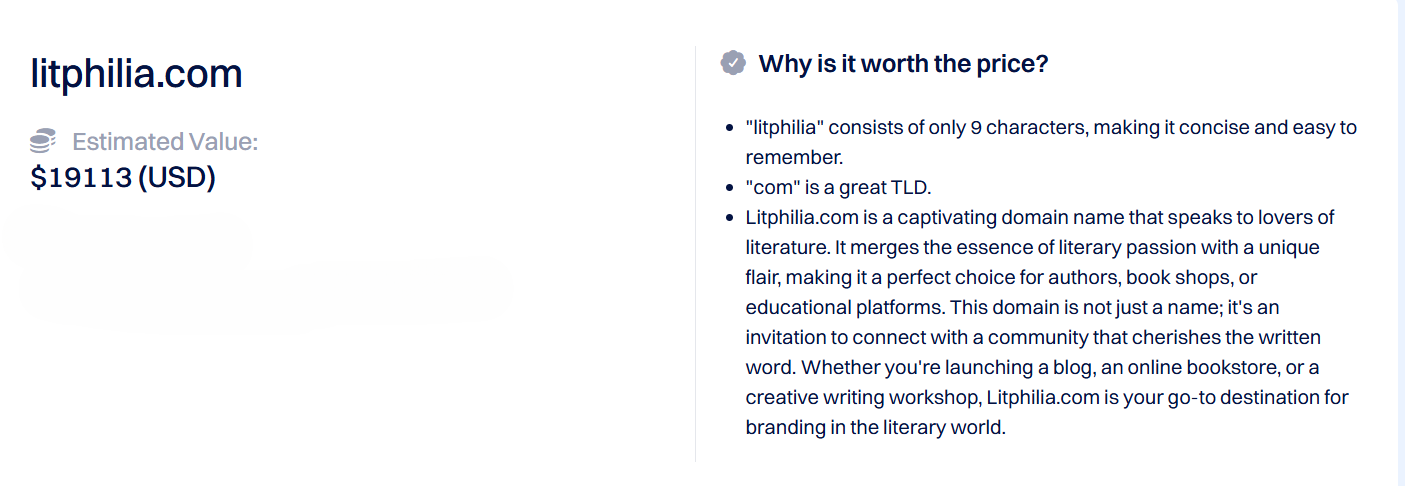
Dynadot — one of the larger domain registrars around — ran their automated appraisal on LitPhilia.com and came back with an estimated market value of $19,113. That's not the asking price here. It's what their algorithm thinks someone might pay for it if it went up for auction among domain investors.
Domain appraisals like this look at a few things: the length of the name (shorter is almost always worth more), how memorable and pronounceable it is, whether the meaning is clear, and what the .com extension adds in trust and recognisability. LitPhilia scores well on all of it.
Think of it a bit like a property valuation — the appraiser isn't setting the final price, just telling you roughly where the market sits. I'm not selling it at $19,000. I'm offering it here, directly, at a fraction of that, because I'd rather it go to someone who'll actually build something with it than sit parked on an auction page waiting for a speculator.